Key Takeaways
- AI has lowered the barrier to professional web design — but it hasn't eliminated the need for strategy, branding, and human expertise
- Small and mid-sized businesses benefit disproportionately from AI-assisted web design through lower costs and faster timelines
- Manufacturing, healthcare, education, and export businesses have the most to gain from AI-augmented websites in 2026
- AI tools excel at layout generation, copy drafts, image optimization, and repetitive production tasks
- AI struggles with brand voice, emotional nuance, strategic conversion thinking, and culturally specific content
- The best results come from combining AI efficiency with human strategic oversight — the hybrid agency model
- SEO in the AI era rewards original, experience-based content — not generic AI output
- Accessibility and Core Web Vitals still require human review to achieve compliance and top Lighthouse scores
Executive Summary
Quick Answer: Can AI design a professional business website?
Yes. In 2026, AI can rapidly generate layouts, content drafts, colour palettes, and design variations that would have taken weeks just three years ago. For many small businesses, this means professional-quality websites at a fraction of the previous cost and timeline.
However, most growing businesses — particularly in manufacturing, healthcare, exports, and B2B services — still benefit significantly from human strategy, branding, UX planning, SEO architecture, accessibility compliance, and conversion optimization. AI is a powerful force multiplier. It is not a replacement for expertise.
This guide covers everything you need to know to make the right decision for your business.
Introduction: The Quiet Revolution No One Announced
Something quietly dramatic happened over the last eighteen months, and most small business owners were too busy putting out daily fires to notice.
Artificial intelligence didn't just knock on the door of web design — it walked in, rearranged the furniture, and started cooking dinner. What used to require a ₹1,00,000+ retainer with a design agency and six weeks of back-and-forth revisions can now, in many cases, be prototyped in an afternoon. That's not hyperbole. That's the reality confronting businesses across Coimbatore, Chennai, Dubai, Singapore, and London right now.
But here's the part most people get wrong: AI hasn't made web designers obsolete. It's made bad web design obsolete. There's a massive difference, and understanding it is probably the single most important thing a small business owner can do before spending another rupee on their digital presence.
The Old Way Was Expensive and Gatekept
If you ran a precision engineering company in Coimbatore or a textile exporter in Tiruppur in 2020, getting a professional website meant one of three paths:
- Hire a freelancer and hope they didn't disappear after the advance
- Sign a contract with a design agency and wait while they "discovered your brand"
- Wrestle with a drag-and-drop builder at midnight and publish something that looked like it was designed by someone who'd seen a website once, from a distance, in a dream
None of these options were great for businesses operating on thin margins with real customers to serve. The knowledge gap was real. Colour theory, typography pairing, responsive breakpoints, conversion rate optimisation, accessibility compliance — these are disciplines that people study for years. Business owners shouldn't have been expected to master them between production runs and export shipments.
Enter AI: What's Actually Changed
The emergence of AI-powered design tools didn't arrive as a single announcement. It was a slow tide that suddenly reached everyone's ankles at once.
Tools appeared that could generate entire website layouts from a text prompt. Others could analyse competitors' sites and suggest improvements. Some could write copy, select images, optimise for search engines, and A/B test different landing page variants — without a human designer touching a single pixel.
For small businesses, this was significant. Not because the technology is perfect (it isn't), but because it dramatically lowered the barrier to entry. A furniture manufacturer in Dubai could suddenly have a website that looked and functioned like it belonged to a company ten times its size. A healthcare clinic in the UK could launch a professional, accessible site in weeks rather than months.
At Seelan Graphics, we've watched this evolution with the kind of fascination usually reserved for watching a controlled demolition. You know the old structure needs to come down. The new one will be better. But the process is intense.
What AI Actually Does Well in Web Design
Quick Answer: AI excels at production tasks — layout generation, copy drafts, image optimisation, and pattern-based decisions. It dramatically accelerates the early stages of web design.
Where AI Delivers Real Value
- Layout generation — Hero sections, feature grids, and navigation structures generated in seconds
- Colour palette suggestions based on industry, mood, and existing brand assets
- First-draft copy that is coherent and structured, even if not yet distinctive
- Image resizing and optimisation across device breakpoints automatically
- Basic UX issue detection — buttons too small on mobile, text contrast failing WCAG standards
- Repetitive production tasks that used to consume hours of a designer's week
- SEO metadata generation — meta titles, descriptions, and schema markup drafts
- Accessibility baseline audits — catching the 30–40% of issues automated tools can identify
The Best AI Tools for Web Design in 2026
| Tool | Best For |
|---|---|
| Framer AI | Full website generation from prompts, modern layouts |
| Lovable | React-based web app generation from natural language |
| Bolt.new | Full-stack prototyping at speed |
| Figma AI | Design iteration, component generation, design systems |
| Webflow AI | No-code CMS websites with AI-assisted design |
| ChatGPT / Claude | Content strategy, copywriting, SEO briefs |
| Gemini | Research, content generation, Google ecosystem integration |
| Midjourney | Custom visual assets, hero images, illustrations |
| GitHub Copilot | Frontend development acceleration, React, JavaScript |
What AI Struggles With
Quick Answer: AI cannot replicate strategic thinking, genuine brand voice, emotional nuance, or the contextual understanding that comes from knowing your specific customers and business goals.
Where AI Falls Short
- Understanding your specific customer — AI doesn't know that your engineering firm's buyers are procurement managers who care about certifications, lead times, and ISO compliance, not aesthetic trends
- Authentic brand voice — AI copy tends toward corporate smoothness that sounds like everyone and no one simultaneously
- Emotional nuance — A memorial services website and a children's education platform require profoundly different design sensibilities; AI can approximate this, but approximation isn't understanding
- Strategic conversion thinking — Should your homepage prioritise phone calls or quote requests? That depends on your sales team's capacity, your average deal size, and your customer's buying behaviour — things a prompt cannot capture
- Knowing when to break the rules — The best design often intentionally violates conventions; AI optimises toward the mean
- Cultural specificity — Content for buyers in the UAE, Singapore, or Germany requires cultural nuance that generic AI models routinely miss
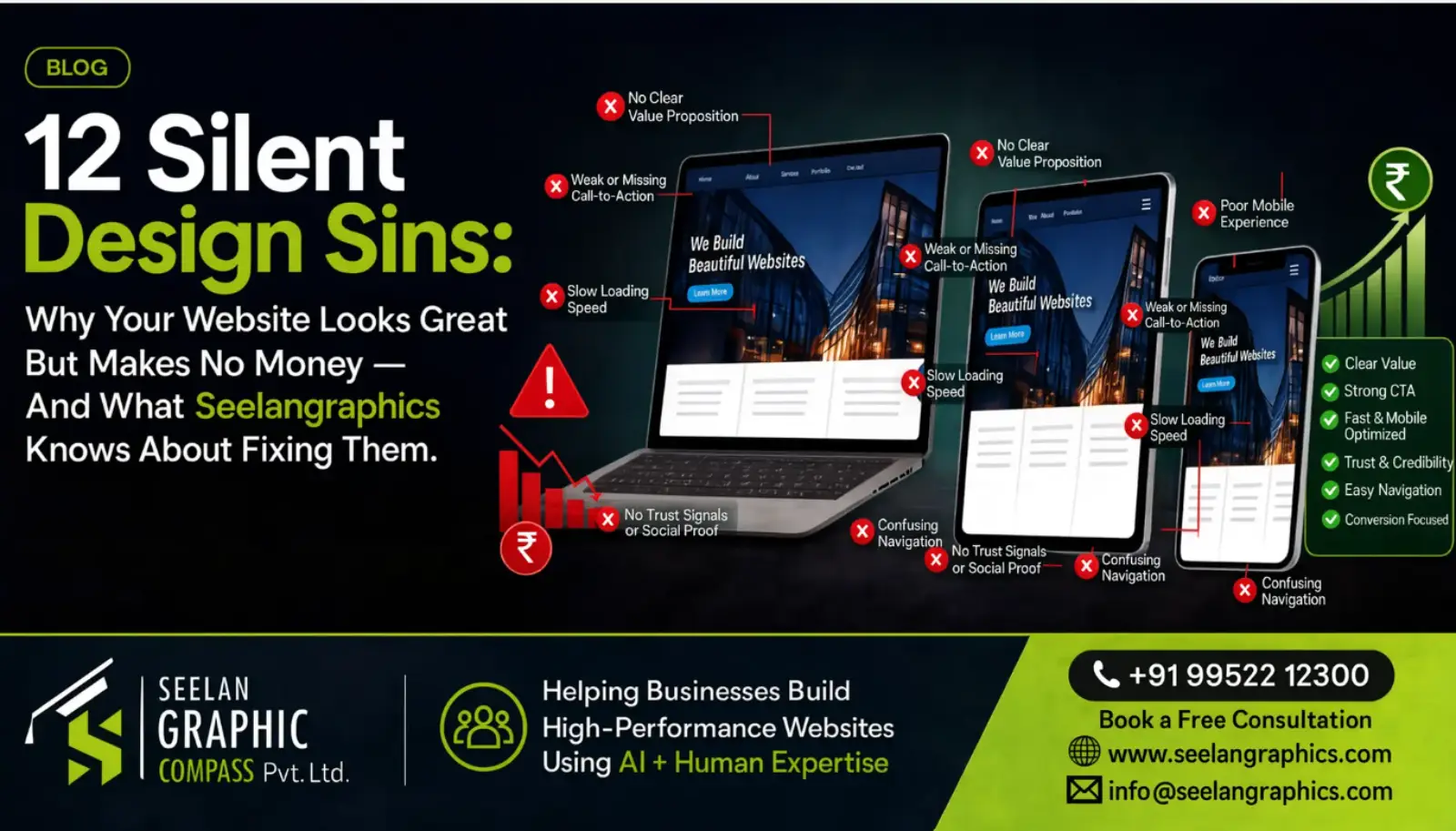
The important distinction: AI-generated sites can look beautiful in a screenshot and completely fail to convert visitors into customers. Pretty isn't the same as effective — and this difference is everything when every enquiry counts. This is one of the 12 silent design sins we've identified — a beautiful website that doesn't convert is expensive digital wallpaper.
Is AI Helping or Hurting Your Website?
Before going further, audit your current site honestly. These are the questions that matter:
- Does your website load in under 2 seconds on a mobile connection?
- Does it generate enquiries or leads consistently?
- Can AI search engines (Google AI Overviews, ChatGPT) understand and surface your content?
- Is it optimised for mobile — not just responsive, but genuinely usable?
- Does it accurately represent your brand, quality, and expertise?
- Can your sales team confidently share it with prospects?
- Does it rank for the search terms your customers actually use?
If you answered "no" to more than two of these, AI-assisted redesign is worth serious consideration regardless of when your site was last built.
AI Web Design vs Custom Website: The Honest Comparison
| Factor | AI Website Builder | AI-Augmented Custom Website |
|---|---|---|
| Setup Speed | Hours to days | 2–4 weeks |
| Customisation | Template-constrained | Fully tailored to your brand |
| Layout Quality | Good for standard businesses | Brand-specific, conversion-focused |
| Content Quality | Generic drafts | Human-refined, EEAT-optimised |
| SEO Depth | Basic | Full technical + content SEO |
| Accessibility | Partial (automated checks only) | WCAG AA compliant |
| Core Web Vitals | Variable | Optimised, Lighthouse 90+ |
| Scalability | Limited | Grows with your business |
| Initial Cost | ₹5,000–₹15,000/yr | ₹20,000–₹80,000+ |
| Long-Term ROI | Lower | Higher |
| Best For | Portfolio, simple info sites | B2B, manufacturing, healthcare, exports |
How Manufacturers and B2B Businesses Are Using AI in Web Design
This is an underreported dimension of AI in web design — the impact on industrial and B2B businesses that have historically had the worst websites in their categories.
Precision Engineering Companies (Coimbatore, Chennai)
Engineering firms use AI to generate detailed product specification pages, capability statements, and technical documentation at scale. AI handles the production volume; human engineers review accuracy. The result: comprehensive websites that previously would have taken months to write and organise.
Textile and Garment Exporters (Tiruppur, Erode)
Export businesses use AI to generate product listings in multiple languages, create buyer-facing documentation, and optimise for international search terms. AI assists with translation; human review ensures cultural and commercial accuracy for buyers in Europe, the USA, and the Middle East.
CNC and Industrial Machinery Manufacturers
AI assists with generating structured content for machinery specifications, application case studies, and industry-specific landing pages. Combined with React-based custom development, these businesses can build authoritative digital presences that support their sales teams internationally.
Healthcare Clinics (India, UK)
Healthcare providers use AI for content generation, patient information pages, and service descriptions — but always with professional medical review. Accessibility compliance in healthcare is non-negotiable, and human testing remains essential.
Educational Institutions
Schools, coaching centres, and EdTech companies use AI to generate course descriptions, FAQs, and admissions content rapidly. Seelan Graphics' Edu Flow platform uses AI-assisted content pipelines to help educational clients maintain fresh, relevant content without dedicated content teams.
SaaS Companies (Singapore, Bangalore)
SaaS startups use AI extensively for landing page iteration, A/B testing copy variants, and rapid feature documentation. Speed-to-market is everything in this segment, and AI's ability to generate testable variants quickly directly supports growth.
Decision Matrix: What's Right for Your Business?
| Business Type | Recommended Approach | Reason |
|---|---|---|
| Precision engineering / manufacturing | Custom website | Complex B2B trust requirements, technical content, international buyers |
| Healthcare clinic | Custom with AI content support | Compliance, accessibility, trust signals are critical |
| Textile / garment exporter | Custom with AI + multilingual | International buyers, product volume, SEO depth |
| Restaurant / café | AI builder + human refinement | Standard pages, lower conversion complexity |
| Educational institution | AI-augmented custom | High content volume, SEO importance, multiple audiences |
| SaaS startup (MVP) | AI builder or hybrid | Speed to market, iterative by nature |
| Export trading company | Custom website | B2B credibility, search visibility, international SEO |
| Portfolio / personal brand | AI builder acceptable | Simple purpose, low complexity |
| Ecommerce (products) | Custom or established platform | Conversion optimisation, inventory management. See our complete ecommerce conversion guide. |
| Professional services firm | AI-augmented custom | Authority, trust, lead generation focus |
The SEO Dimension: AI's Double-Edged Sword
Quick Answer: AI tools have made basic SEO accessible to everyone. But Google's own AI has simultaneously raised the bar for what earns rankings. The businesses that win are those producing genuinely useful, experience-based content — not those flooding the web with generic AI output.
What AI Has Made Accessible
- Keyword research and clustering
- Meta title and description generation
- Schema markup implementation
- Internal linking suggestions
- Content brief creation
- Technical SEO audit identification
What AI Cannot Manufacture
- Genuine expertise signals (EEAT) — Google's helpful content systems increasingly reward content that demonstrates real-world experience and first-hand knowledge
- Locally specific insights — A Coimbatore-based engineering firm writing about the specific procurement challenges of Tamil Nadu's MSME sector has authenticity no AI can replicate
- Industry authority — Deep, accurate technical content in sectors like manufacturing, healthcare, or finance requires domain expertise that AI can support but not replace
The opportunity for small businesses: If you create genuinely useful, experience-based content — the kind only someone who actually runs your type of business would know — you will stand out. This is an inherent advantage small business owners have over generic AI content farms.
Accessibility: The Quiet Revolution AI Is Enabling
Web accessibility — making your site usable by people with disabilities — isn't just ethically important. It's a legal requirement in many markets, including India (under RPwD Act guidelines), the UK (Equality Act), and the USA (ADA).
Lawsuits against businesses with inaccessible websites have been rising consistently year over year internationally.
What AI Can Now Do for Accessibility
- Automated WCAG contrast checking
- Alt text generation for images
- Navigation structure analysis for screen reader compatibility
- Keyboard navigation pattern identification
- Form label validation
What Still Requires Human Expertise
- Screen reader testing with real assistive devices
- Cognitive load and plain language review
- Complex interactive component accessibility
- Cultural and language accessibility for international audiences
AI now catches approximately 30–40% of accessibility issues automatically. Combined with human expert review, businesses can achieve genuine WCAG AA compliance — something that was prohibitively expensive for most small businesses just three years ago.
Performance and Core Web Vitals: Where AI Helps and Where It Doesn't
Quick Answer: AI tools can identify performance issues and suggest optimisations, but achieving consistent Lighthouse scores above 90 requires hands-on technical implementation.
AI Contributions to Performance
- Image compression and format conversion (WebP, AVIF)
- Identifying render-blocking resources
- Suggesting lazy loading implementations
- Code quality suggestions via tools like GitHub Copilot
What Requires Human Technical Work
- Code splitting and bundle optimisation
- Proper caching headers on CDN (CloudFront, Cloudflare)
- Critical CSS extraction
- Third-party script management
- React performance optimisation (memoisation, dynamic imports)
At Seelan Graphics, we target Lighthouse scores of 95+ on all React-based builds. This is achievable with AI assistance, but the final 15–20 points require experienced frontend engineering.
How Seelan Graphics Uses AI Responsibly
We believe in being transparent about how we work, because agencies that pretend AI doesn't exist are being dishonest, and agencies that claim AI replaces professional expertise are being reckless.
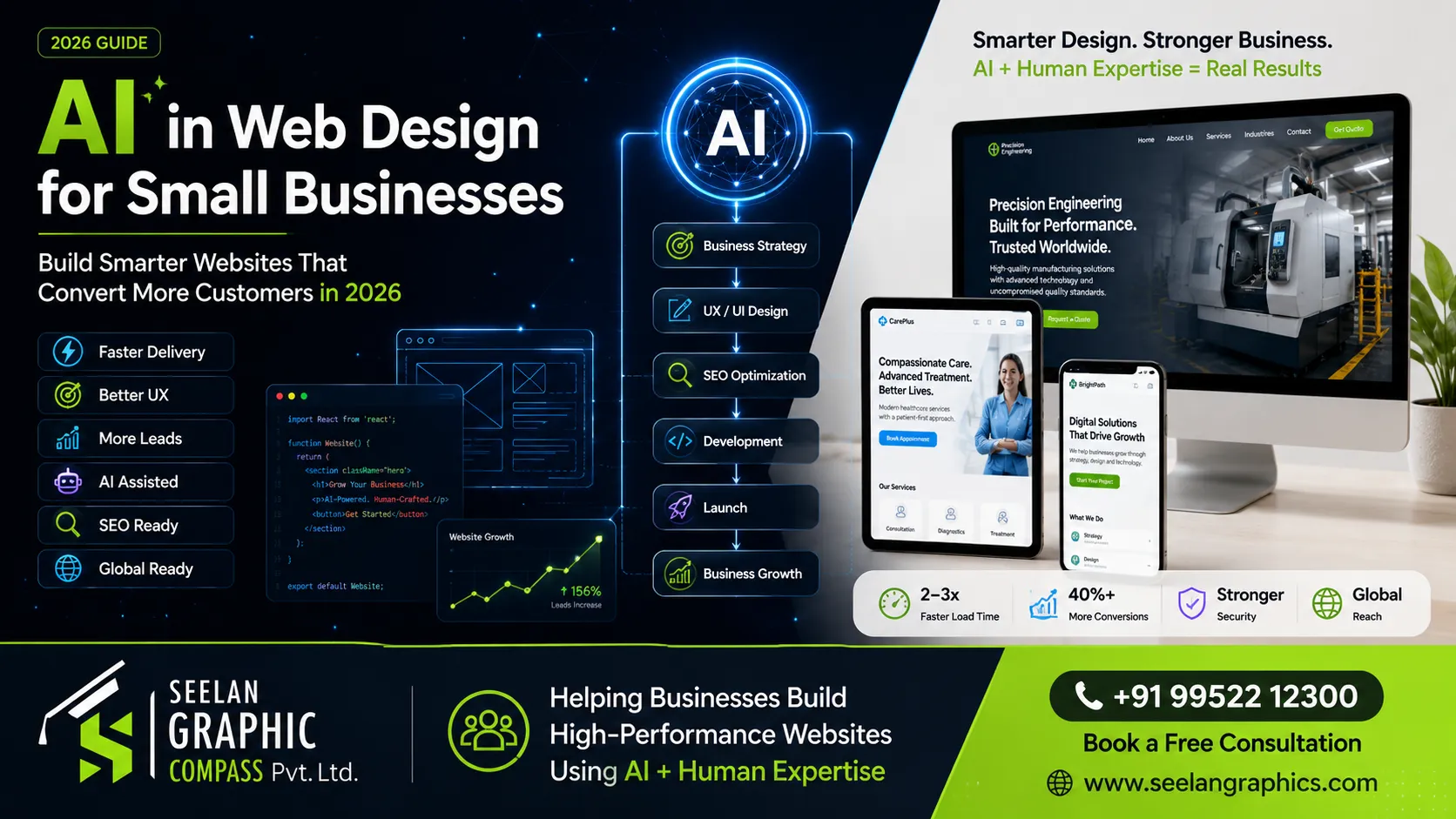
Our AI-Augmented Workflow
- AI-assisted research — Competitor analysis, keyword clustering, content briefs
- AI-generated layout concepts — Initial wireframes and design variations
- Human UX review — Strategic refinement, conversion focus, brand alignment
- AI-supported content drafts — Structural copy generation
- Human content refinement — Voice, EEAT signals, industry accuracy
- React development — Custom component architecture, performance engineering
- Manual performance optimisation — Lighthouse 95+, Core Web Vitals targets
- Accessibility testing — Automated + human review against WCAG AA
- SEO review — Technical + content, schema, canonicals, sitemap
- Security review — Static architecture, dependency auditing
- Cloud deployment — AWS S3 + CloudFront, prerendering pipeline
The result for our clients: Better websites, faster turnaround, and lower costs — without lower quality. In many cases, quality has gone up because our designers spend time on high-value strategic decisions rather than production tasks.
This is not unlike how power tools changed skilled carpentry. A skilled carpenter with the right tools produces better work faster. Giving those tools to someone without the underlying expertise just means making mistakes at higher speed.
The "Set It and Forget It" Trap
Here's where we push back against utopian narratives circulating in marketing content.
AI-generated websites are not fire-and-forget solutions. The small business owner who prompts an AI tool to build their site and never touches it again is making the same mistake as the one who paid an agency in 2018 and hasn't updated since.
The web is a living medium. Google's algorithms evolve. User expectations shift. Your business changes. A website that isn't being maintained and optimised is slowly becoming a liability.
What AI does is make ongoing maintenance more accessible and less expensive. It does not eliminate the need for it. This distinction is critical, and it gets lost in the hype.
Real Costs: What to Expect in 2026
| Approach | Cost Range (India) | Timeline | Best For |
|---|---|---|---|
| DIY AI builder | ₹5,000–₹15,000/yr | 1–3 days | Simple info sites, portfolios |
| AI builder + freelancer | ₹15,000–₹40,000 | 1–2 weeks | Small local businesses |
| AI-augmented agency | ₹30,000–₹80,000 | 2–4 weeks | Growing SMEs, professional services |
| Fully custom React | ₹80,000–₹2,00,000+ | 4–8 weeks | Manufacturing, exports, healthcare, SaaS |
For a deeper breakdown of website costs across every tier — including hidden costs, maintenance budgets, and how to choose the right investment — see our complete, brutally honest guide to business website costs in India.
Important context: The "lower cost" option frequently carries a higher opportunity cost. A DIY AI site that generates zero enquiries has cost your business far more than the build fee. We've had clients come to us after 6–12 months with a DIY AI site, having spent considerably more in lost business than a professional build would have cost.
What's Coming Next: An Honest Prediction
Within the next two to three years, AI will produce genuinely sophisticated first-draft websites for most standard small business use cases. The technology trajectory makes this near-certain.
This will pressure agencies and freelancers who compete purely on execution. If the only value you offer is "I will build you a website," the future is difficult.
But if what you offer is strategy, brand thinking, conversion optimisation, and the kind of contextual understanding that comes from actually talking to a human about their business goals — that becomes more valuable as execution gets commoditised. Not less.
For small businesses, this trajectory is overwhelmingly positive. More competition among service providers, lower costs, faster timelines, and better tools for maintaining your own site. The businesses that lean into this — seeing AI as a tool rather than either a saviour or a threat — are the ones that will thrive.
Practical Steps for Small Business Owners Right Now
-
Audit your current website ruthlessly. Open it on your phone. Is it fast? Is the text readable without zooming? Can someone figure out what you do and how to contact you within five seconds? If not, you have a problem AI tools can help solve.
-
Stop treating your website as a digital brochure. Your website is a salesperson who works around the clock. Every page should have a purpose. Every section should move a visitor toward an action.
-
Don't chase trends blindly. A clean, fast, clear website outperforms a flashy, slow, confusing one every single time. This was true before AI. It will be true after.
-
Invest in content, not just design. The content that ranks in search engines and resonates with customers has a human fingerprint — your expertise, your specific knowledge of your customers, your genuine experience. AI can structure it. It cannot create it from nothing.
-
Consider a hybrid approach. AI efficiency combined with human strategic and creative oversight gives you the best of both. Lower costs and faster timelines, without sacrificing quality or conversion.
-
Plan for ongoing maintenance. A website is not a one-time purchase. Budget for quarterly content updates, annual technical reviews, and conversion optimisation over time.
Conclusion: Your Website Is a Conversation, Not a Monument
Your website isn't a building. It's a conversation — the ongoing dialogue between your business and the people you serve.
AI can help you have that conversation more effectively, more affordably, and more beautifully than ever before. But the substance of what you're saying — your expertise, your values, your genuine understanding of your customers' problems — that has to come from you.
No algorithm will replicate the moment a business owner explains the problem they solve and why it matters to the people they serve. That's the spark that turns a collection of pages into something that actually connects. AI can amplify that spark. It cannot create it.
At Seelan Graphics, we believe the future belongs to businesses that combine human authenticity with technological capability. The businesses that will lead in their categories are not the ones that adopt AI uncritically, nor the ones that resist it. They're the ones that use it intelligently — as a tool in service of a clear strategy.
If that's the kind of future you want to build for your business, we'd love to talk about it.
This article was last reviewed on June 28, 2026 by the Technical Lead at Seelan Graphics. For questions about AI-assisted web design for your business, contact our team.
About Seelan Graphics
Seelan Graphics (registered as Seelan Graphic Compass Private Limited) is a web design, digital marketing, and SaaS development company based in Peelamedu, Coimbatore, Tamil Nadu, India.
We provide SEO and digital marketing services, web design and development, custom software development, Branding & Corporate Gifting and UI/UX design for businesses across Coimbatore, Tiruppur, Erode, Salem, Chennai, Bangalore, and international markets including Dubai (UAE), the UK, and the USA.
Seelan Graphic Compass Private Limited Sivasakthi Nagar, Peelamedu, Coimbatore 641004, Tamil Nadu, India 📞 +91-99522-12300 | 🌐 seelangraphics.com | ✉️ Contact Us