
Key Takeaways
- Website pricing in India ranges from ₹5,000 to ₹25,00,000+ — the difference isn't just quality, it's what the website is actually designed to do for your business
- The ₹15,000–₹50,000 range is the most dangerous — you're paying enough to expect something decent but not enough for most providers to deliver truly professional work
- ₹50,000–₹1,50,000 is the professional sweet spot for most small-to-medium businesses — custom design, proper SEO, performance optimization, and genuine strategic thinking. For a deeper look at why AI-augmented custom websites deliver this value, see our guide on AI in web design.
- Hidden costs are the #1 budget killer — domain, hosting, content creation, maintenance, email hosting, and post-launch marketing are routinely underestimated
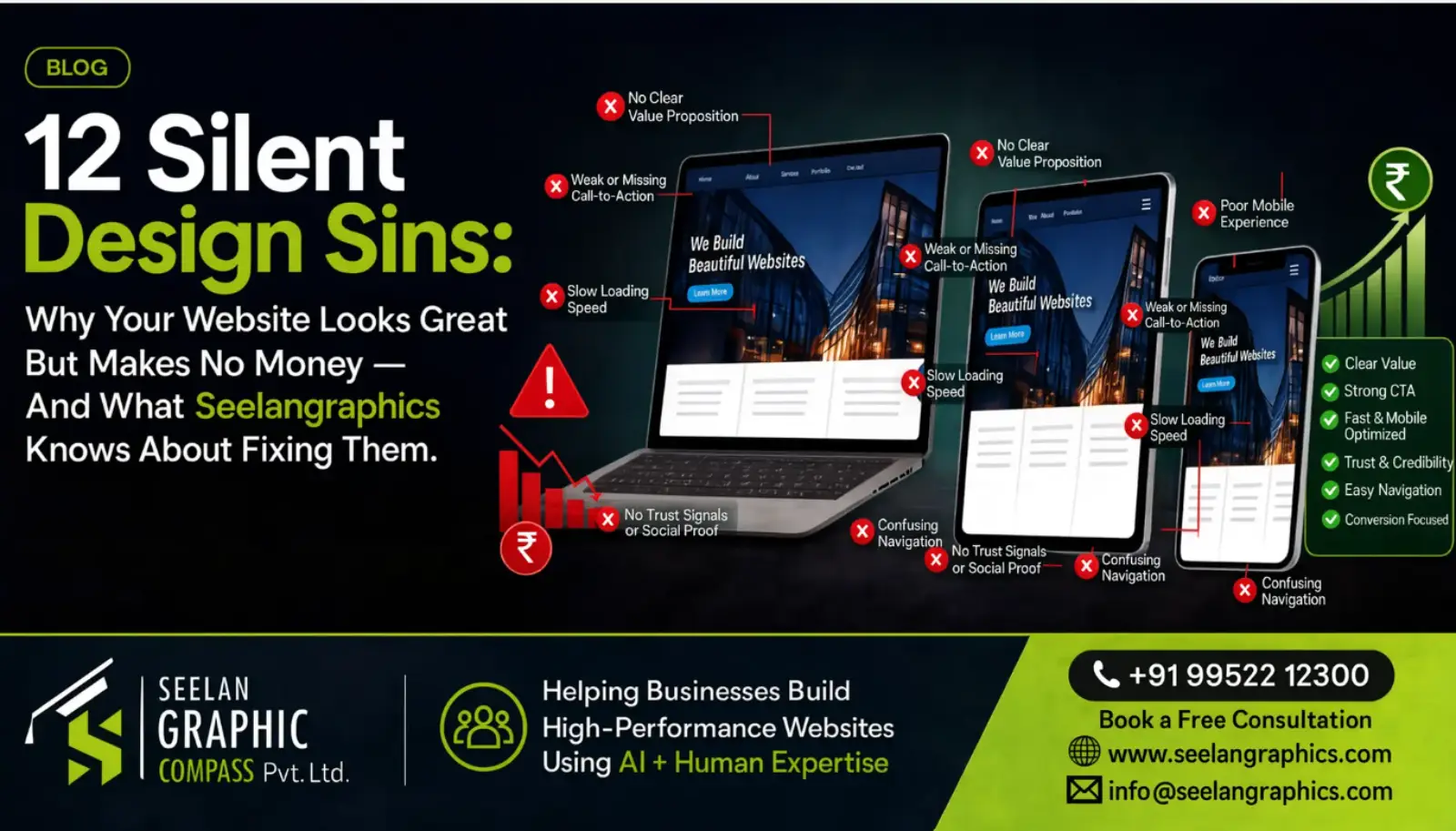
- A ₹10,000 website that needs redoing in a year costs more than a ₹1,00,000 website that drives business growth for three years. This is one of the 12 silent design sins we've identified — cheap sites often commit multiple conversion-killing mistakes.
- DIY/no-code platforms are viable for simple needs but have a ceiling — they rarely match professionally built sites on SEO, conversion, or long-term value
- Choose based on customer lifetime value, not budget — a website that pays for itself in weeks is worth far more than a cheap one that generates nothing
Executive Summary
Quick Answer: How much does a business website cost in India in 2026?
The honest answer: anywhere from ₹5,000 to ₹25,00,000+ — and both extremes can be either a great investment or a complete waste of money, depending entirely on what your business needs.
This guide provides a real-world map of what your rupees actually buy at every price tier in the Indian web design market, as it exists right now. No generic pricing tables. No marketing spin. Just straight talk about what separates a ₹10,000 website from a ₹2,00,000 one — and how to decide which investment makes sense for your business.
Introduction: The ₹5,000 to ₹25,00,000 Problem
Every year around budget season, business owners across India have the same awkward conversation with developers, agencies, and freelancers. It usually starts with a WhatsApp message: "Bhai, ek website banana hai. Kitna lagega?" And the answer they receive ranges anywhere from ₹5,000 to ₹25,00,000 — which, frankly, is about as helpful as telling someone that a car costs "between ₹3 lakh and ₹3 crore." True? Sure. Useful? Not remotely.
Now, here's the thing about 2026: the web design and development landscape in India has shifted in ways most pricing articles haven't caught up with yet. AI-assisted design tools have matured. No-code platforms have eaten into the low end of the market. Meanwhile, custom development costs have actually increased because experienced developers are in higher demand than ever — many of them pulled toward international remote gigs paying in dollars and euros. The rupee-dollar dynamic, the post-pandemic digital urgency that never really faded, and the explosion of D2C brands and service businesses going online have all reshaped what things cost and, more importantly, what you actually receive for your money.
At Seelan Graphics (seelangraphics.com), we've built websites across virtually every price bracket, and we've watched clients thrive — and struggle — at each one. This isn't a generic pricing table. It's a real-world map of what your rupees buy you in the Indian web design market as it exists right now, in 2026.
Why Website Pricing in India Is So Wildly Inconsistent
Before we get into actual numbers, it's worth understanding why the pricing landscape is so chaotic. Because if you don't understand the why, you'll never be able to evaluate the what.
Web design isn't like buying cement or steel — there's no standardized unit of measurement. A "5-page website" from one provider is fundamentally different from a "5-page website" from another. One might be a WordPress theme with your logo slapped on; another might be a custom-designed, conversion-optimized digital experience with original copywriting, SEO architecture, and performance tuning.
India also has an unusually deep talent pool spread across wildly different cost-of-living regions. A solo developer in Madurai operates with different overheads than an agency in Gurugram. Both might be equally skilled — or one might be dramatically better than the other. You genuinely cannot tell from the price alone.
Add to this the fact that many clients don't know what they're buying. They compare quotes like-for-like when the deliverables are apples and aircraft carriers. That confusion is, honestly, the single biggest reason businesses end up either overpaying for mediocrity or underpaying and getting something they have to redo within eighteen months.
The ₹5,000 – ₹15,000 Range: Template Territory
Let's start at the bottom, because a lot of startups and small businesses begin here, and that's not always wrong.
What you get: A pre-built template (usually WordPress or Wix) with your business name, logo, contact information, and maybe 3–5 pages: Home, About, Services, Contact, maybe a Gallery. The design is functional but generic. Someone installs a theme, changes the colors to match your brand (loosely), drops in your content — which you usually have to provide yourself — and hands you the keys.
What you don't get: Custom design. Original copywriting. SEO beyond maybe installing a plugin. Mobile optimization beyond whatever the template provides by default. Speed optimization. Security hardening. Any post-launch support worth mentioning.
Who this works for: If you're a freelancer, a tuition teacher, a local electrician — someone who just needs a digital business card that shows up when people Google you — this tier genuinely works. I'd rather see a small business owner spend ₹10,000 on a clean template site and invest the rest in Google Business Profile optimization than blow ₹2 lakh on a site they don't need yet.
The catch: These sites age poorly. They load slowly because nobody optimized them. They look like seventeen other businesses in your city. And if your business grows, you'll almost certainly outgrow this website within a year or two and need to start over.
The ₹15,000 – ₹50,000 Range: Where Things Start Getting Real (And Risky)
This is the most dangerous price bracket in Indian web design. I say that with full conviction.
At this level, you're paying enough to expect something decent, but not enough for most providers to deliver truly professional work. It's a no-man's-land. Some brilliant freelancers operate here and deliver outstanding value. Some agencies also operate here and deliver garbage — because they're cutting every corner to make the math work.
What you should get at this price: A semi-custom WordPress or similar CMS website. The designer should be selecting and heavily modifying a premium theme — not just installing a free one. You should get 5–10 well-structured pages, basic on-page SEO (proper title tags, meta descriptions, heading structure, image alt text), mobile responsiveness that's been actually tested on real devices, a contact form that works, Google Analytics integration, and at least a month or two of post-launch bug-fix support.
What you often get instead: A premium theme installed with minimal customization, stock images everywhere, no SEO whatsoever, a vague promise of "we'll fix any issues," and then radio silence after the final payment clears.
The insider tip: At this price point, your vendor selection matters more than any other factor. A talented freelancer charging ₹35,000 can outdeliver a sloppy agency charging ₹50,000. Ask for their last five projects. Actually visit those websites. Check them on Google PageSpeed Insights. See if those sites rank for anything on Google. The portfolio tells the truth that the sales pitch won't.
Who this works for: Small businesses that are serious about their online presence but don't yet have the revenue to justify a premium investment. Restaurants, clinics, coaching institutes, small manufacturing firms, local service providers — if you choose your developer wisely, this range can serve you well for 2–3 years.
The ₹50,000 – ₹1,50,000 Range: The Professional Sweet Spot for Small-to-Medium Businesses
Now we're talking. This is the range where, in 2026's Indian market, you start getting genuinely professional output — the kind that can actually drive business results rather than just existing as a digital placeholder.
What this budget buys you:
- Custom design — not a modified template, but layouts designed specifically for your brand, your content, and your user journey. A designer should be creating mockups in Figma or Adobe XD before any code gets written.
- Professional copywriting — or at least copy editing and content structuring. The difference between a website that converts visitors into inquiries and one that doesn't is almost always the words on the page, not the design.
- Proper SEO foundation — keyword research, URL structure planning, schema markup, XML sitemap, robots.txt configuration, page speed optimization, and internal linking strategy. Not just installing Yoast and calling it a day.
- Performance optimization — image compression, lazy loading, caching configuration, clean code. Your site should load in under 3 seconds on a decent mobile connection.
- SSL certificate, security basics, and regular backup setup.
- CMS training — someone should walk you through how to update your own content.
- 3–6 months of basic maintenance support.
What separates good from great at this level is strategic thinking. A good developer at this price doesn't just ask "what pages do you want?" They ask "what do you want the website to do?" They think about user flows. They consider what happens when someone lands on the Services page — where should the eye go? What's the next action? What objection might they have? This is the difference between a website and a business asset.
At Seelan Graphics, many of our most successful projects for growing businesses fall in this range. It's where budget meets ambition in a workable way.
The ₹1,50,000 – ₹5,00,000 Range: Custom Everything, and It Shows
Once you cross the ₹1.5 lakh threshold, you're entering territory where the website becomes a serious competitive advantage. This is where established businesses, funded startups, professional service firms (law offices, architecture studios, financial advisors), and mid-sized companies typically land.
What you're paying for:
- Fully custom UI/UX design, often with multiple rounds of revisions and stakeholder input sessions.
- Custom-coded functionality — calculators, booking systems, client portals, interactive elements, complex contact forms with conditional logic.
- Advanced SEO — not just on-page but technical SEO, content strategy, competitor analysis, and possibly an initial content calendar.
- E-commerce capability with proper payment gateway integration (Razorpay, PayU, CCAvenue, etc.), inventory management, tax calculations for GST compliance, and shipping logic if applicable. For a deep dive into what makes an ecommerce site generate real revenue, see our ecommerce conversion guide.
- Multi-language support (Hindi-English bilingual sites are increasingly common, and in South India, Tamil-English or Telugu-English).
- Integration with CRMs, email marketing platforms, WhatsApp Business API, and other tools your business uses.
- Comprehensive testing across devices, browsers, and connection speeds.
- 6–12 months of maintenance and support, sometimes including a certain number of monthly update hours.
The uncomfortable truth about this range: Not every business needs to be here. I've seen companies spend ₹4 lakh on a website when a ₹80,000 one would have served them perfectly — because an agency upsold them on features they never used. Custom client portals that nobody logs into. Elaborate animations that slow down the site. A blog section with exactly zero posts two years later.
Before you spend at this level, be honest with yourself: Do you have the content, the operational capacity, and the ongoing marketing plan to justify this investment? If yes, absolutely go for it. If no, start at the previous tier and upgrade later.
The ₹5,00,000 – ₹15,00,000 Range: Digital Experiences, Not Just Websites
We're now in premium territory. At this budget, you're not buying a website — you're buying a digital experience platform. The clients here are typically mid-to-large companies, funded startups with serious growth ambitions, healthcare chains, educational institutions, real estate developers, hospitality brands, or B2B companies where the website is the primary sales engine.
What this looks like in practice:
- A dedicated project team: UI/UX designer, front-end developer, back-end developer, project manager, content strategist, QA tester. Sometimes an SEO specialist is embedded from day one.
- Discovery phase with stakeholder interviews, user persona development, competitor audits, and information architecture mapping before any design begins.
- Headless CMS architecture or custom frameworks (React, Next.js, or similar) for performance and scalability.
- Advanced e-commerce builds with thousands of SKUs, dynamic filtering, customer accounts, wishlists, loyalty programs, and seamless checkout experiences.
- Performance engineering — sites at this level should score 90+ on Core Web Vitals consistently.
- Accessibility compliance (WCAG standards), which is becoming increasingly important in India, particularly for government-adjacent or international-facing businesses.
- Content migration from legacy systems.
- Post-launch analytics setup with custom dashboards, conversion tracking, and often a 30-60-90 day optimization plan.
Something people rarely talk about: At this investment level, the process matters as much as the output. You should receive a detailed project timeline, regular status updates (weekly at minimum), staging environment access so you can review progress, and formal sign-off gates before the project moves between phases. If a vendor at this price point is winging it, that's a massive red flag.
The ₹15,00,000+ Range: Enterprise-Grade Digital Infrastructure
Now we're at the top of the market. Projects at this level are common among large enterprises, multi-location hospital chains, nationwide e-commerce brands, fintech companies, edtech platforms, and government or institutional bodies.
What justifies this cost:
- Complex web applications — not static websites but dynamic platforms with user authentication, dashboards, real-time data processing, API integrations with multiple third-party systems, and often mobile app synchronization.
- Custom ERP or CRM integration where the website isn't a standalone entity but a connected node in a larger business ecosystem.
- High-availability infrastructure with CDN deployment, auto-scaling servers, DDoS protection, and 99.9% uptime SLAs.
- Legal and regulatory compliance — PCI-DSS for payment processing, data protection standards for health data (India's DPDP Act 2023), and data localization requirements.
- Ongoing retainer for development, maintenance, security monitoring, and iterative improvement — because sites at this level are never truly "done."
This is specialized territory. If your business needs are genuinely this complex, you already know it — and the price conversation becomes less about "how much" and more about "which partner can deliver reliably at scale."
Hidden Costs That Nobody Mentions Until It's Too Late
Let me save you from learning these the hard way, because nearly every first-time website buyer gets blindsided by at least one:
Domain registration: ₹500–₹1,500/year for a .com or .in domain. Some providers include this; many don't.
Hosting: Anywhere from ₹2,000/year for shared hosting (fine for small sites) to ₹50,000+/year for managed cloud hosting (necessary for high-traffic or complex sites). Cheap hosting is the #1 killer of website performance in India. I cannot stress this enough. A beautifully designed site on ₹99/month hosting is like putting premium petrol in a car with a broken engine.
SSL certificate: Often included with hosting now, but verify. Without HTTPS, Google penalizes your rankings and Chrome shows a "Not Secure" warning to visitors. Non-negotiable in 2026.
Content creation: Photos, videos, copywriting. If you don't have professional photos and you don't budget for a photographer, your ₹3 lakh website will look like a ₹30,000 website. Content is the most underbudgeted line item in web projects across India.
Ongoing maintenance: WordPress sites need regular updates, security patches, backup verification, and occasional troubleshooting. Budget ₹5,000–₹25,000/year minimum, or ₹1,000–₹5,000/month for active maintenance retainers. A website without maintenance is a ticking time bomb — hacking incidents on unmaintained Indian WordPress sites have skyrocketed.
Email hosting: Professional email (yourname@yourbusiness.com) through Google Workspace or Zoho Mail runs ₹1,500–₹6,000/year per user. Some clients assume this comes with the website. It doesn't, usually.
Post-launch SEO and marketing: Building a website without a plan to drive traffic to it is like opening a shop in a basement with no signboard. Budget for at least basic SEO and Google Business Profile optimization, or that gorgeous new site will sit there unseen. For Coimbatore businesses specifically, our local SEO guide covers exactly what works in 2026.
How to Decide What You Should Actually Spend
Here's a framework I've found genuinely useful, rather than just throwing numbers at you:
Calculate your customer lifetime value (CLV). If a single new customer is worth ₹50,000 to your business over time, and a good website brings you even 2–3 new customers per month, a ₹2,00,000 website pays for itself in weeks. If a customer is worth ₹500 and you get most of your business through walk-ins and word of mouth, spending ₹5,00,000 on a website is probably premature.
Think in terms of investment horizon. How long do you expect this website to serve your business? If it's a stopgap while you figure out your branding, spend less. If it's the foundation for the next 3–5 years of growth, invest accordingly.
Factor in your own time. A cheaper website often means more of your time spent managing it, providing content, dealing with issues. Your time has a cost too. Sometimes paying more upfront saves you hundreds of hours downstream.
Don't compare your business to someone else's. A SaaS startup's website needs are fundamentally different from a local bakery's. Instagram-famous D2C brands need different things than B2B manufacturing companies. Your website investment should reflect your business model, your customers, and your growth stage — not what your competitor spent.
A Quick Word About DIY and No-Code Options in 2026
Platforms like Wix, Squarespace, Shopify, and even WordPress.com have gotten remarkably capable. Webflow, in particular, has become a serious tool for design-savvy business owners. If you're tech-comfortable, design-literate, and your needs are straightforward, you can build a respectable site for ₹10,000–₹30,000/year (platform fees, domain, and hosting combined) without hiring anyone.
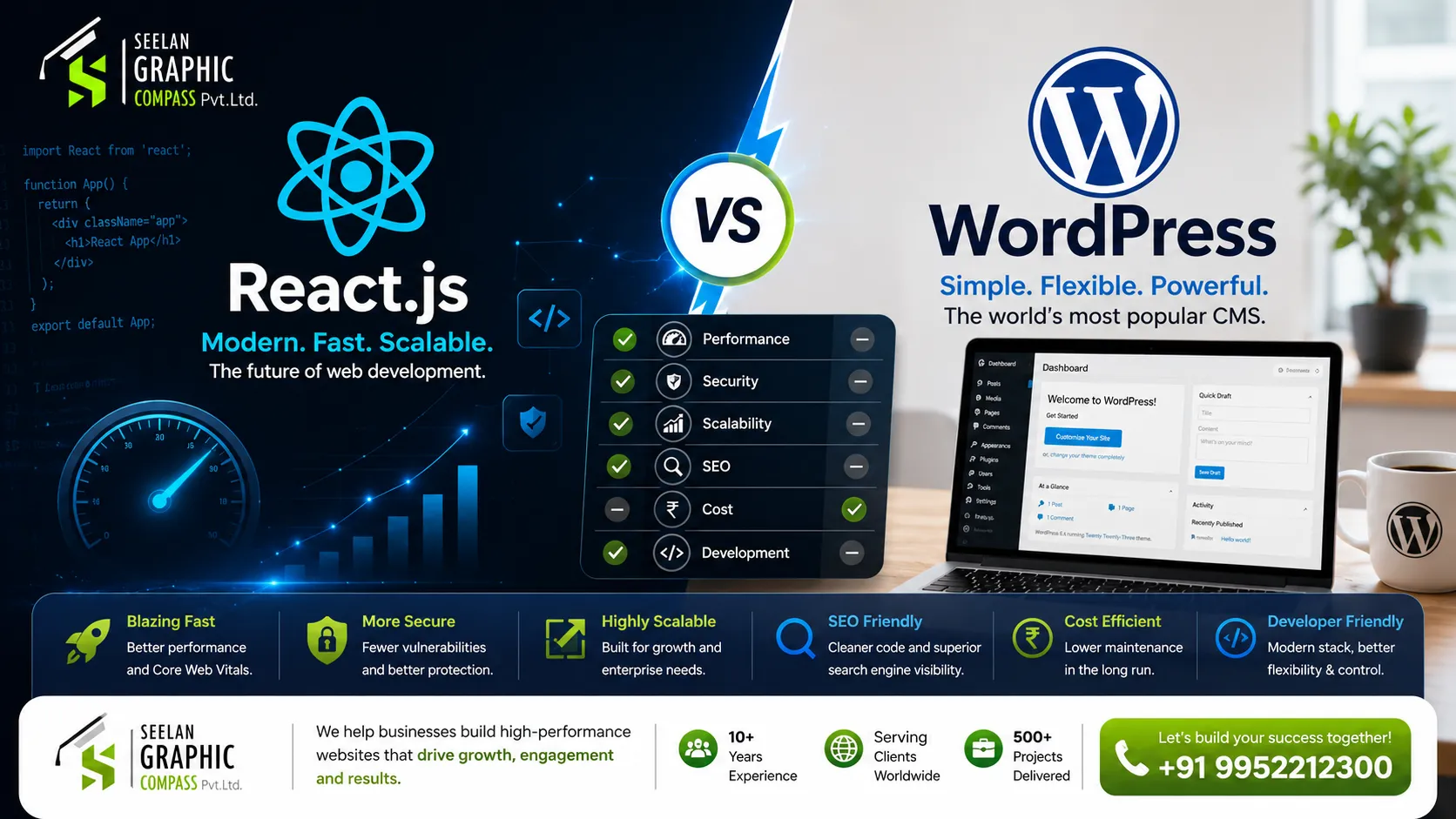
But — and this is a significant "but" — DIY sites have a ceiling. They tend to look DIY. They're rarely optimized for SEO in any meaningful way. They don't convert as well as professionally designed sites because conversion optimization is a skill, not a feature. And you'll spend considerable time maintaining them — time that might be better spent running your business. For a detailed comparison of the platform options, read our React.js vs WordPress guide.
DIY makes sense for validating a business idea quickly, for personal brands, for side projects. For a serious, growing business? Partner with professionals and treat your website as the strategic asset it is.
What Makes Seelan Graphics Different at Any Price Point
At seelangraphics.com, we've deliberately structured our services to deliver genuine value across multiple budget levels. We don't believe in a one-size-fits-all approach because businesses aren't one-size-fits-all.
What we consistently bring, regardless of budget tier:
- Honest scoping. We'll tell you if you're overspending for your current needs — even if it means a smaller project for us.
- Design thinking, not just design. Every layout decision connects to a business objective.
- SEO built into the foundation, not bolted on as an afterthought.
- Transparent pricing with no hidden costs surfacing mid-project.
- Post-launch relationship. We don't disappear after the site goes live.
Whether you're a startup in Chennai needing a sharp five-page site or an enterprise in Mumbai building a complex digital platform, the approach is the same: understand the business first, then build the website that serves it.
Final Honest Thoughts
The Indian web design market in 2026 offers extraordinary value compared to Western markets — this is objectively true. A website that would cost $10,000–$15,000 in the US can be built for ₹2–4 lakh in India at comparable quality, provided you choose the right partner.
But "cheap" and "good value" are not the same thing. A ₹10,000 website that you need to redo in a year cost you ₹10,000 plus the opportunity cost of having a bad website for twelve months. A ₹1,00,000 website that drives measurable business growth for three years cost you roughly ₹2,700 per month — probably the best marketing investment you'll make.
Don't shop for the cheapest website. Shop for the right one.
And when you're ready to have that conversation — a real, strategic one about what your business actually needs online — come talk to us at Seelan Graphics. No pressure, no inflated quotes, no smoke and mirrors. Just straight talk from people who build websites for a living and genuinely care about getting it right.
References & Further Reading
- Beaird, Jason, and James George. The Principles of Beautiful Web Design. 5th ed., SitePoint, 2020.
- Duckett, Jon. HTML and CSS: Design and Build Websites. John Wiley & Sons, 2011.
- Garrett, Jesse James. The Elements of User Experience: User-Centered Design for the Web and Beyond. 2nd ed., New Riders, 2010.
- Krug, Steve. Don't Make Me Think, Revisited: A Common Sense Approach to Web Usability. 3rd ed., New Riders, 2014.
- Ministry of Electronics and Information Technology, Government of India. "Digital India Programme." meity.gov.in.
- National Informatics Centre, Government of India. "Guidelines for Indian Government Websites (GIGW)." web.guidelines.gov.in.
- Nielsen, Jakob, and Hoa Loranger. Prioritizing Web Usability. New Riders, 2006.
- Reserve Bank of India. "Handbook of Statistics on Indian Economy." rbi.org.in.
- World Wide Web Consortium (W3C). "Web Content Accessibility Guidelines (WCAG) 2.2." w3.org/TR/WCAG22. 2023.
This article was last reviewed on July 9, 2026 by the Technical Lead at Seelan Graphics. For a free consultation on the right website investment for your business, contact our team.
About Seelan Graphics
Seelan Graphics (registered as Seelan Graphic Compass Private Limited) is a web design, digital marketing, and SaaS development company based in Peelamedu, Coimbatore, Tamil Nadu, India.
We provide SEO and digital marketing services, web design and development, custom software development, Branding & Corporate Gifting and UI/UX design for businesses across Coimbatore, Tiruppur, Erode, Salem, Chennai, Bangalore, and international markets including Dubai (UAE), the UK, and the USA.
Seelan Graphic Compass Private Limited Sivasakthi Nagar, Peelamedu, Coimbatore 641004, Tamil Nadu, India 📞 +91-99522-12300 | 🌐 seelangraphics.com | ✉️ Contact Us